Cancer Fighting Foods & The Role of Diet in Cancer
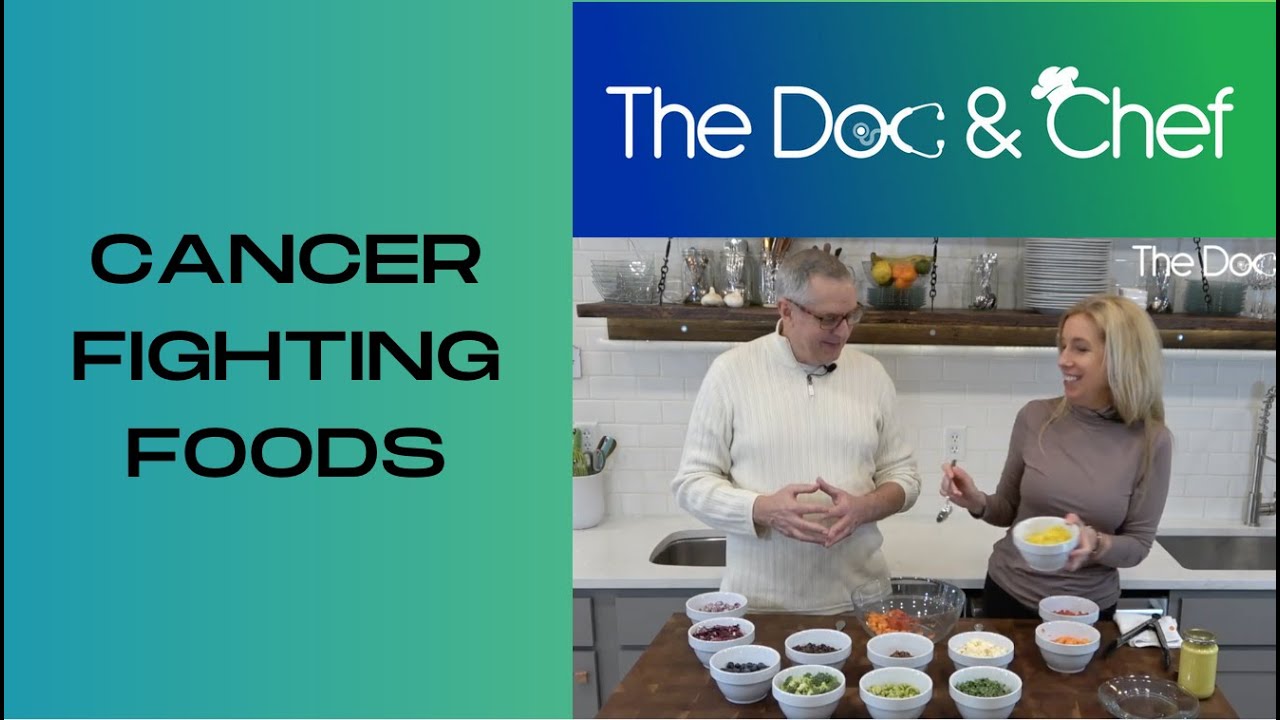
Click the image above to watch the episode!
Close to 2 million people in the United States were diagnosed with cancer last year. And we know that over half of cancer deaths are preventable. Diet now contributes more to cancer risk than smoking! So knowing what foods increase your risk of getting cancer and which ones lower your risk is very important in helping you lead a long, cancer-free life.
Foods that have been linked to a higher rate of cancer include processed and red meat, partly related to the heme iron in red meat and the nitrates in the cured meats.
We know that dairy products have been linked to certain kinds of cancer, especially prostate cancer. Dairy contains insulin growth factor I, or IGF-1 and elevated levels of IGF-1 have been associated with an increased risk for cancer.
The way you prepare your foods can also increase the risk for cancer. Fried foods create chemicals like acrylamide, which has been shown to be a carcinogen (carcinogens are compounds that increase your risk for cancer). Grilling or roasting meat at high temperatures forms other kinds of carcinogens such heterocyclic amines (HAs) and polycyclic aromatic hydrocarbons (PAHs).
[1] CA Cancer J Clin. 2022 Jan;72(1):7-33.
[2] https://www.nature.com/articles/d41586-022-02355-x
[3] Pharm Res. 2008 Sep;25(9):2097-116.
[4] https://www.hsph.harvard.edu/nutritionsource/cancer/preventing-cancer/
[5] Eur J Epidemiol. 2021 Sep;36(9):937-951
[6] Eur J Cancer Prev. 2012 Mar;21(2):134-8
[7] The American Journal of Clinical Nutrition, Volume 116, Issue 2, August 2022, Pages 314–324
[8] Eur J Nutr. 2020 Jun;59(4):1413-1420.
[9] https://www.cancer.gov/about-cancer/causes-prevention/risk/diet/acrylamide-fact-sheet
[10] Control Expo Risk Assess. 2008 Jan;25(1):2-24.
We know that excess sugar intake from highly sugared, ultra-processed foods or sweetened beverages increases your risk for cancer, through several mechanisms. Excess sugar intake is associated with obesity, which can cause chronic inflammation and is associated with increased cancer risk and excess insulin which is also associated with increased risk.
Unfortunately, these high fat, highly processed foods make up most of the calories in the standard Western diet.
On the other hand, there are many foods that have been shown to lower the risk of cancer. Many work because they have anti-inflammatory properties and we know that chronic inflammation is at the core of many chronic diseases, including cancer. In general, the more color foods have, the more anti-inflammatory they are , so that’s why it is so important to “eat the rainbow”! Remember “ROY G BIV”? Well, that stands for red, orange, yellow, green, blue, indigo, and violet! Here are some examples of foods across the spectrum of the rainbow.
Red: Tomatoes have a compound called lycopene which is a very potent antioxidant, and has been shown to decrease both the risk of prostate cancer, but also breast cancer.
Orange: Carrots are high in a compound called beta carotene, another very potent antioxidant that's been associated with a lower risk of colon cancer, for example. And Bugs Bunny's favorite food. Yeah,
Yellow: Yellow bell peppers are probably one of the best sources of vitamin C (you can choose any color bell pepper), another very potent antioxidant.
Green: Kale is a cruciferous vegetable. Cruciferous vegetables have a family of compounds called glucosinolates which are associated with a lower risk of cancer.
Green: Edamame is soybeans and regular soy consumption has been shown to lower the risk of breast cancer, and if you've had breast cancer it lowers the risk of recurrence. It can also lower the risk of prostate cancer in men.
Green: Broccoli, which is another cruciferous vegetable. Broccoli has a compound called sulforaphane, which has been shown to help lower the risk of cancer.
Blue: Blueberries are probably one of the most powerful anti-cancer foods out there. It's also been shown to help prevent things like Alzheimer's disease. The cancer fighting properties come the pigments in the skin that make it blue.
Indigo: Red cabbage is another cruciferous vegetable.
[11] Am J Clin Nutr. 2020 Nov 11;112(5):1267-1279.
[12] Exp Diabetes Res. 2012;2012:789174
[13] Mo Med. 2020 Nov-Dec;117(6):536-538
[14] PLoS One. 2019 Apr 12;14(4):e0214551
[15] Nutrients. 2022 Dec 3;14(23):5152.
[16] Antioxidants (Basel). 2021 Nov 26;10(12):1894.
[17] Rocz Panstw Zakl Hig. 2012;63(4):389-95.
[18] Front Nutr. 2022 Mar 4;9:847421.
[19] J Oral Maxillofac Pathol. 2020 May-Aug;24(2):405
[20] Anticancer Agents Med Chem. 2013 Oct;13(8):1142-8
Violet: Red onion is in a family called the allium vegetables. Other vegetables in this family include garlic, leeks, and green onion. They are very high in compounds like allicin and quercetin, which have been shown to have antibacterial, anti-inflammatory and anti-cancer properties.
And just because a food doesn’t have a lot of bright colors doesn’t mean it doesn’t have anticancer properties. For example, cauliflower is another cruciferous vegetable with anti-cancer properties.
Quinoa , which is a pseudo-grain, is high in fiber, which can help prevent colon cancer and may also have direct anti-cancer properties.
Black beans are also high in fiber and contain anti-inflammatory compounds derived from the pigments in the skin.
There are also many herbs and spices that have been shown to have anti-cancer properties. The one that has been studied the most is turmeric. Turmeric contains curcumin, which has been shown to have marked anti-inflammatory, anti-cancer properties.
The bottom line is that if you want to minimize your risk of getting cancer, the key is a healthy lifestyle, which includes maintaining a healthy weight, regular physical activity, limiting or eliminating alcohol, don’t smoke and probably most important eating the rainbow!
[21] Front. Nutr., 23 March 2022, Volume 8 - 2021
[22] https://www.cancer.gov/about-cancer/causes-prevention/risk/diet/cruciferous-vegetables-fact-sheet
[23] Molecules. 2022 Apr 11;27(8):2453
[24] Chem Cent J. 2017 Jun 20;11(1):56.
[25] Int J Mol Sci. 2019 Feb 27;20(5):1033
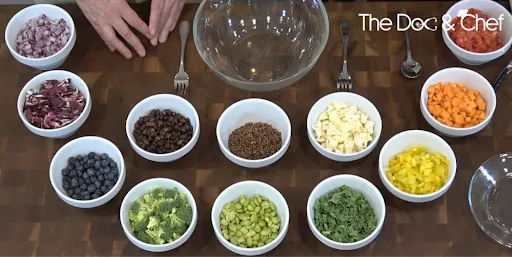
RAINBOW SALAD
2 cups broccoli, chopped
2 cups cauliflower, chopped
2 large tomatoes, chopped
1 bunch leafy greens, chopped
1 cup shelled edamame
1 cup red cabbage, chopped
1 red onion, chopped small
2 carrots, chopped
1 bell pepper (any color), chopped
2 cups cooked quinoa
2 cups cooked black beans
Essentially what you’re doing is creating a cancer fighting salad bar in your fridge. You might not add all of these ingredients into your bowl, simply pick the ones you like!
Here’s a great dressing you’ll swoon over:
½ cup tahini
6 dates, pitted and soaked in hot water for 15 minutes
1/2 “ ginger root, minced
½ teaspoon dried turmeric
juice of ½ lemon
freshly ground black pepper tt
1-2 cloves of garlic
water
Add all ingredients to a blender and drizzle in water to desired consistency.
Will keep for 5 days in a sealed container in the fridge.
Want to learn more from the Doc & Chef? Get the medical guidance, practical cooking skills, and supportive community you need to finally succeed with plant-based living—without the confusion or overwhelm. Join the community today.


© 2025 The Center for Plant-Based Living. All Rights Reserved.